
What Size of Kidney Stone Requires Surgery?
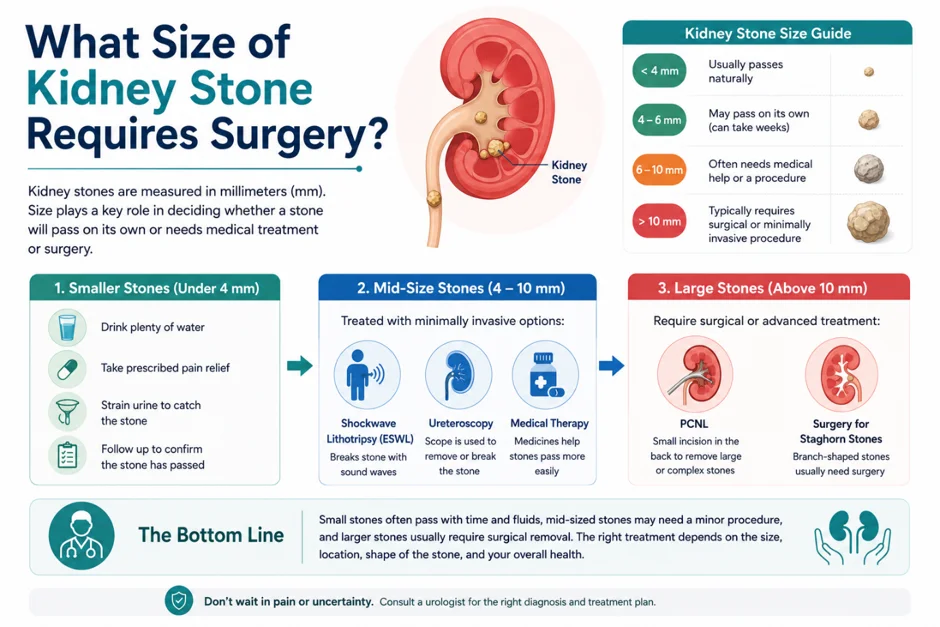
A sudden, sharp pain in the back or side sends many people straight to the emergency room, only to learn the cause is a kidney stone. Once the shock settles, the next question almost everyone asks is: what size of kidney stone requires surgery? It’s a fair question, because size plays a huge role in deciding whether a stone passes on its own or needs a doctor’s help to remove it.
Let’s break this down clearly, so you know what to expect at each stage.
How Are Kidney Stones Measured, and Why Does Size Matter?
Kidney stones are measured in millimeters, and that number matters more than most patients realize. A stone the size of a grain of sand behaves very differently in the body than one the size of a small marble.
Size affects three things directly:
- Whether the stone can pass through the urinary tract on its own
- How much pain and blockage is it likely to cause
- Which treatment option, medication, a minimally invasive procedure, or surgery, makes the most sense
So, What Size of Kidney Stone Requires Surgery?
Here’s a general guide doctors use, though every case is still evaluated individually:
- Under 4mm: Usually passes naturally with fluids and time
- 4mm to 6mm: May pass on its own, though it can take weeks and cause discomfort along the way
- 6mm to 10mm: Often needs medical help, sometimes with medication, sometimes with a procedure
- Above 10mm: Typically requires a surgical or minimally invasive procedure to remove safely
These numbers are a helpful starting point, not a strict rulebook. Location, shape, and whether the stone is blocking urine flow all shape the final decision.
What Happens With Smaller Stones?
Stones under 4mm are the most forgiving. Many patients pass these without ever needing a procedure. Doctors typically recommend:
- Drinking plenty of water to help flush the stone out
- Taking prescribed pain relief during the passing process
- Straining urine to catch the stone for lab analysis
- Following up to confirm the stone has fully passed
This stage can be uncomfortable, but it’s rarely dangerous when monitored properly.
When Is a Stone Treated Without Full Surgery?
For stones in the mid-size range, doctors often try less invasive options first:
- Medical expulsive therapy: Certain medications relax the ureter, helping stones move along more easily
- Shockwave lithotripsy (ESWL): Sound waves break the stone into smaller pieces from outside the body, which are then passed naturally
- Ureteroscopy: A thin scope is passed through the urinary tract to remove or break up the stone, usually without any external cuts
These options are far less invasive than traditional surgery, and recovery is generally quick.
What Size Typically Needs Surgical Removal?
Larger stones, generally above 10mm, or stones that block urine flow completely, are harder for the body to manage alone. In these cases, doctors may recommend:
- Percutaneous nephrolithotomy (PCNL): A small incision in the back allows direct removal of large or complex stones
- Surgery for staghorn stones: These branch-shaped stones fill parts of the kidney and almost always require surgical treatment
While the word “surgery” can sound frightening, these procedures are well-established, and most patients recover within a few weeks.
The Bottom Line for Patients and Families
No single stone tells the same story twice, but the right treatment plan always starts with knowing its size.
Understanding what size of kidney stone requires surgery helps take some of the fear out of the diagnosis. Small stones often resolve with patience and fluids, mid-sized stones may need a minor procedure; and larger stones usually call for surgical removal. As Dr. Chandan Chaudhari, kidney transplant specialist often tells patients, the goal is never to rush into surgery unnecessarily, but to choose the safest, most effective path for each individual case. If you’re dealing with kidney stone symptoms, don’t wait it out in uncertainty; reach out to a urologist and get a clear picture of your options.